21 January 2025
Company Liquidation in Hong Kong
Learn the main steps of company liquidation in Hong Kong, when it becomes necessary and which steps the procedure involves. Our lawyers can assist.

Company liquidation in Hong Kong takes place when companies can no longer pay their debts or are faced with other situations that make this step necessary. There are many reasons why a business can fail to obtain the desired results and encounter financial difficulties that can cause its owners to close the business altogether.
The decision to close a company in Hong Kong can be made with the help of professional consultants. Our law firm in Hong Kong can offer you specialized counseling before and during the company liquidation procedure.
Company de-registration in Hong Kong
A company in Hong Kong can be de-registered if it fulfills certain conditions. This is a simpler procedure to close the company, compared to liquidation or winding up. A company can be de-registered if all of its members agree that this is the necessary step. Moreover, the company must not have any outstanding liabilities.
| Quick Facts | |
|---|---|
| Reasons for company liquidation in Hong Kong | Profit decline, debts, corporate restructuring, etc. |
| The effects of company liquidation | A company that is liquidated (wound up) is brought to an end. |
| Types of voluntary company liquidation in Hong Kong | Members' voluntary winding up (solvent company) or creditors' voluntary winding up (insolvent company); both are started by a resolution of the members, not by the creditors. |
| Compulsory winding up | By the High Court |
| Reasons for compulsory company winding up in Hong Kong | When the company cannot pay debts of $10,000 or more and in other cases. |
| Voluntary winding up steps | Passing a resolution to wind up the company, creditor’s meeting, liquidator appointment, debt settlement, company dissolution. |
| Compulsory winding up steps | Filing a winding up petition, Cour hearing, Winding up order by Court, creditor’s meeting, liquidator appointment, debt settlement, company dissolution. |
| Business activities during voluntary dissolution | No, unless needed to complete the winding up process. |
| Void activities during company liquidation | Any transfer of shares or changes to the member’s status. |
| The liquidator’s role | Settles the dents, convenes meetings as needed, handles the final distribution of assets to shareholders (if any remain after paying the creditors). |
| Director’s powers | The director’s powers cease upon the appointment of a liquidator. |
| Director’s duties | Assist the liquidator as needed by providing access to the company’s assets and books. |
| Creditor’s duties | After the winding up order is made, the creditors must prove the debt they are owed by the company to the liquidator. |
| Alternatives to winding up the company | Negotiate a debt repayment schedule with the creditors in the case of a creditor’s voluntary liquidation. |
| Liquidation process duration | Approximately one year |
Another requirement for de-registration is that the company has never started any business operations or it ceased to perform any business operations for more than 3 months immediately before commencing the de-registration procedure. Also, the company owners must have decided not to resume business in the future. In order to de-register a company a Notice of No Objection must first be obtained from the Inland Revenue Department, and then an application (Form NDR1) must be made to the Companies Registry.
Our lawyers in Hong Kong can help you fill out the necessary forms and submit the necessary documents for de-registration. If you are considering the necessary steps to close a company in Hong Kong, our team can also offer guidance on some of the common practices for company restructuring – if the option to salvage the business is still available.
Voluntary winding up a company in Hong Kong
During the winding-up procedure, the company’s assets are used to repay its debts and satisfy the claims of its creditors. Winding up can be voluntary or compulsory.
Winding up a company in Hong Kong in a voluntary manner can take the form of a members’ voluntary winding up (solvent company) or a creditors’ voluntary winding up (insolvent company, controlled by the creditors).
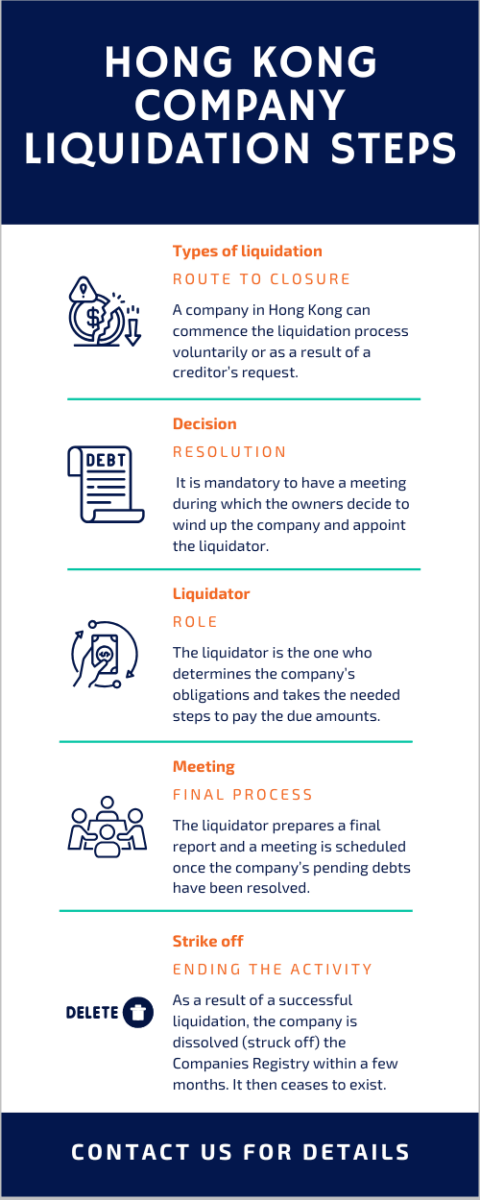
The main steps involved in voluntary company liquidation in Hong Kong are the following:
- A general meeting of the members has to take place during which the members pass a special resolution to wind up the company and appoint a liquidator to carry out the process;
- The company directors must make a Certificate of Solvency (Form NW1) and deliver it to the Companies Registry;
- If the company is unable to make the Certificate of Solvency, then a creditor’s voluntary winding up takes place. In this case, the creditors will be those to appoint a liquidator.
- The liquidator handles the distribution of the company’s assets to its creditors; he has the power to schedule periodic meetings with the creditors to keep them updated on the status of the winding up;
- when all the debts are repaid, the liquidator will present a final situation of the winding up during a scheduled meeting of the company’s shareholders and its creditors.
Once the voluntary winding up begins, the Hong Kong company ceases its activities. However, it may still engage in business purposes that are relevant or required for a straightforward winding up process.
A company that is under liquidation will retain its legal capacity/legal status until the completion of its dissolution.
After the winding up begins, any change to the company’s status or its members, or any transfer of shares will be considered void. Our attorneys in Hong Kong can give you more details about this issue if you are considering the closure of a business and still need to make changes to the company’s particulars.
The two types of liquidation are described in the following video:
Compulsory company closure in Hong Kong
Winding up a company in Hong Kong in a compulsory manner takes place when the High Court of the Hong Kong Special Administrative Region decides to wind up the company. The most common circumstances in which this is decided are:
- The company cannot pay a debt of HK$10,000 or more;
- The court believes that the company should be wound up;
- The company has made a special resolution that stipulates this action.
The essential steps during compulsory company liquidation in Hong Kong are summarized below by our attorneys:
- the creditors issue a demand for their debts to be repaid to the concerned company;
- a winding up petition is presented in front of the Court;
- the court schedules a hearing and grants the winding up order;
- meetings of creditors and contributories are held to choose a liquidator;
- the liquidator is appointed;
- the company’s assets are distributed to the creditors;
- the liquidator completes his duties and is released from his role;
- the Hong Kong company is dissolved.
A notable aspect concerning compulsory company liquidation in Hong Kong/compulsory winding up is that the powers of the directors cease, but these individuals will still be bound to certain duties during the process.
The director will be responsible for keeping proper books of accounts during the liquidation, as well as preparing the statement of affairs. Failure to do so may result in the prosecution of the company director, by the Official Receiver’s Office in Hong Kong. In other cases, the individual acting as company director can also be subjected to disqualification actions.
To avoid any director liabilities during the winding up of the company, you can reach out to our lawyers in Hong Kong to find out more about the duties of the company director.
Company dissolution statistics in Hong Kong
The Companies Registry offers us comprehensive information on the number of business closures that take place in the HKSAR. In 2025, 69,358 companies were de-registered, 28,783 were struck off and 1,265 were dissolved by liquidation. Earlier monthly data for 2024 are presented below by our Hong Kong lawyers:
- In January 2024 there were 4,578 de-registrations, and 73 liquidations, with a total of 1,865 companies being stuck off the Register;
- In February the number of liquidations was slightly lower, at 62, and 8,630 companies were de-registered;
- in March, 70 companies were liquidated and 2,545 were struck off;
- in April there were 76 liquidated companies and in May, there were 85 liquidated legal entities.
Our law firm offers a wide range of legal services for companies and private clients. If you are interested in other matters, our immigration lawyers in Hong Kong can answer questions about residency in Hong Kong.
Whatever the case and regardless of the liquidation method, our Hong Kong law firm can guide you throughout the process and offer you the necessary legal assistance. Please contact our attorneys in Hong Kong if you want to know more about closing a company.